

Key takeaways
- A timing chain should last the life of the engine
- Early failure is a defect, not wear and tear
- A warranty should pay, but the Act holds the dealer either way
- For 6 months the dealer must prove the fault was not there
- BMW N47, Ford EcoBoost and VW/Audi TFSI have a documented history
A timing chain failure can destroy an engine in seconds, leaving you with a repair bill of thousands or a car that is only worth scrapping. There are two routes to the cost: the warranty, if there is one, and the Consumer Rights Act 2015, which holds the dealer responsible for the car whether there is a warranty or not. This guide covers both, the engines with a known chain history, and the letter to send.
Is a timing chain covered under warranty?
Usually, yes. A timing chain is a core mechanical component with no scheduled replacement interval, so it is not a wear-and-tear item. A manufacturer's warranty (typically 3 years or 60,000 miles, longer for some brands) should cover a failed chain, tensioner or guides. The common pushback is an allegation of missed servicing, so keep your oil-change records: poor oil maintenance is the one thing that genuinely shortens a chain's life.
Used-car and aftermarket warranties are less reliable. Many cap the payout well below the cost of a chain-related engine rebuild, or exclude "consequential damage", which in practice means the destroyed engine rather than the chain itself. Read the policy's exclusions before relying on it.
If a dealer or warranty company has already refused the claim, the refusal changes nothing about your position under the Act. Your Consumer Rights Act 2015 claim against the dealer is separate from any warranty, and usually stronger. A warranty is a contract with whatever limits its small print sets. The Act is statute. If the chain failed prematurely, the dealer who sold you the car is liable whether or not a warranty applies, and "it's out of warranty" is not a defence to a claim under the Act.
Not sure which window you are in? Put in your reg and find out, free.
Is a timing belt covered under warranty?
A belt is different, because it is a service item with a change interval, usually somewhere between 60,000 and 100,000 miles or a set number of years. A belt that snaps before its interval, on a car that has been serviced to schedule, is a defect and a warranty should cover it. A belt that snaps after a missed change is not, and the same logic applies under the Act: durability is judged against the maintenance the manufacturer specifies, so the service history is the whole argument. Ford's 1.0 EcoBoost "wet belt" is the exception people search for most, and it has its own guide.
Timing chain vs timing belt
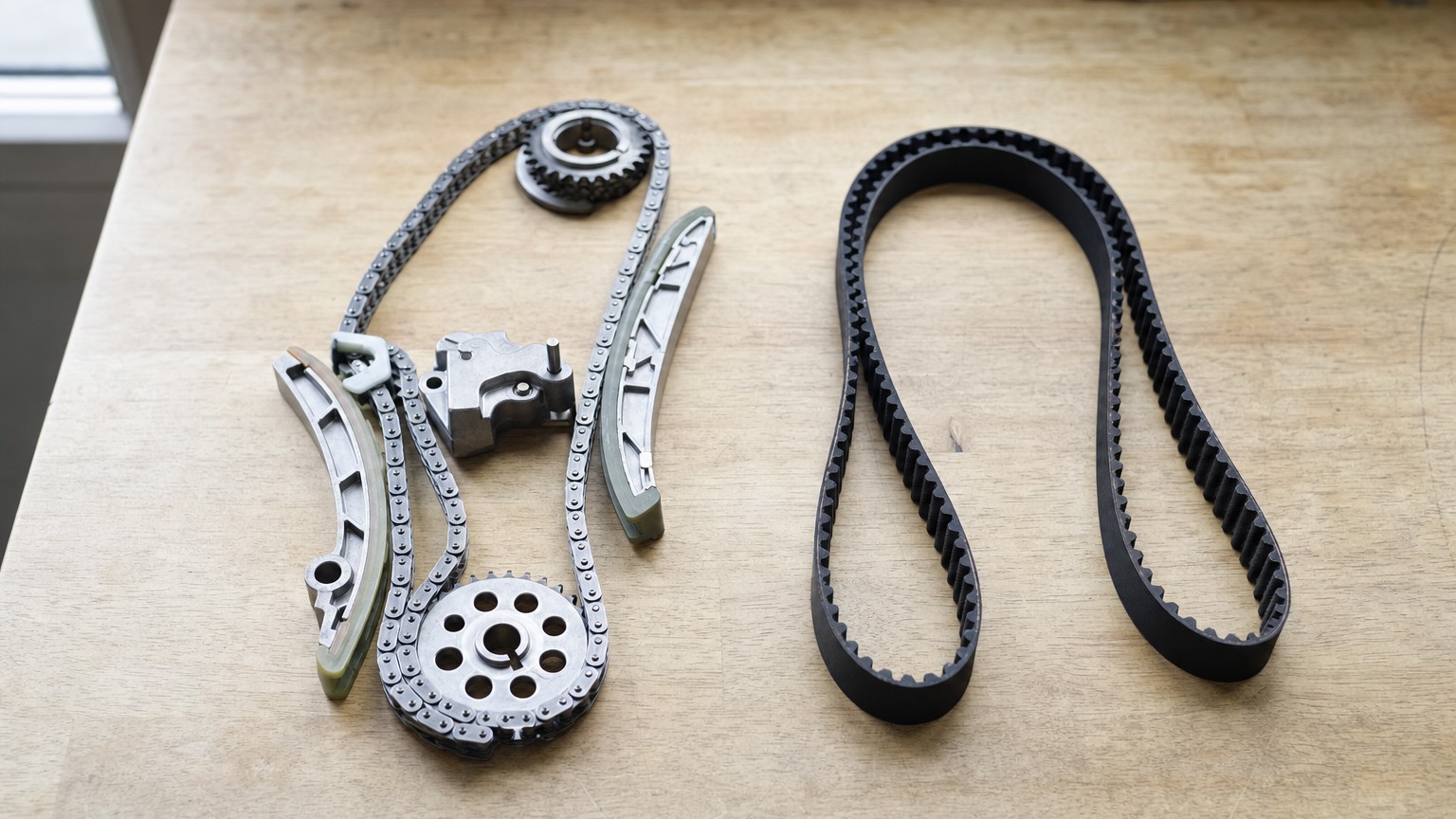
Timing chains are metal and designed to last the lifetime of the engine, typically 200,000 miles or more.
Timing belts are rubber and need replacing at intervals, usually every 60,000 to 100,000 miles.
If your car has a timing chain and it failed at normal mileage, that is usually a defect. It was not supposed to fail.
Warranty or the Consumer Rights Act: which to use
Use both if you can, but understand what each one gives you. The warranty is quicker when it pays out. The Act is the one that holds the dealer to the whole car, including the engine the chain took with it.
A warranty
The Consumer Rights Act
Who pays
A warranty: The manufacturer or the warranty company, on the terms of the policy.
The Act: The dealer who sold you the car. If you bought on finance, the lender too.
How long
A warranty: Typically 3 years or 60,000 miles from new. Used-car warranties often run 3 to 12 months.
The Act: Up to 6 years from purchase in England and Wales, 5 in Scotland.
What it covers
A warranty: The parts listed in the policy, often with a claim cap. Many exclude “consequential damage”, which is the engine the chain destroyed.
The Act: The whole car being of satisfactory quality, which includes durability. A chain that fails early fails that test.
The usual pushback
A warranty: “You missed a service.” Keep the oil-change records.
The Act: “It’s wear and tear.” A chain has no replacement interval, so it is not a wear item.
Who has to prove it
A warranty: You, under the policy’s claims process.
The Act: The dealer, for the first 6 months after purchase. After that, you.
The row that decides most timing chain cases is the last one. For the first 6 months after purchase the law presumes the fault was there when you bought the car, and the dealer has to prove otherwise. A chain does not fail in an instant. The stretch, the tensioner wear and the rattle were developing on the forecourt.
What does the timing chain do?
The timing chain (or timing belt in some cars) synchronises the engine's moving parts. It connects the crankshaft to the camshaft, ensures valves open and close at the right moment, and must stay perfectly timed for the engine to run.
When it fails, valves can hit pistons, the engine suffers catastrophic internal damage, and repairs often cost more than the car is worth.
Engines known for timing chain problems
BMW N47 & N57 (2007-2014)
The most notorious. Affects the BMW 1 Series (116d, 118d, 120d), BMW 3 Series (318d, 320d), BMW 5 Series (520d), and BMW X1 and X3. The chain tensioner and guides fail, the chain stretches, and the engine is destroyed. Multiple class actions and widespread reports make this a well-documented issue. See our full BMW N47 timing chain rights guide for specific advice on these engines.
BMW/Mini Prince engine (2006-2015)
Affects the Mini Cooper and One, Peugeot 207, 208 and 308, and Citroën C3, C4 and DS3. The problem is timing chain stretch at low mileage.
Ford 1.0 EcoBoost (2012-2020)
Affects the Ford Fiesta, Focus, and EcoSport. Coolant loss leads to overheating and timing issues. The wet belt design is particularly problematic. See our Ford EcoBoost wet belt guide.
Audi/VW 2.0 TFSI (2004-2013)
Affects the Audi A3, A4 and TT, VW Golf and Passat, and Seat Leon. The problem is timing chain tensioner failure.
Mercedes M271 (2002-2014)
Affects the Mercedes C-Class and E-Class. The problem is chain stretch and sprocket wear.
Your consumer rights
The car must be "durable"
Under Section 9 of the Consumer Rights Act 2015, goods must be of "satisfactory quality". This explicitly includes durability: the car should remain of satisfactory quality for a reasonable time.
A timing chain that fails at 60,000 miles, when designed to last 200,000 or more, is not durable.
How long you have owned the car decides the rest
First 30 days
Short-term right to reject
Your strongest right. Reject outright and demand a full refund with no deduction. The dealer cannot insist on repairing it first, and the refund is due within 14 days.
30 days – 6 months
One repair, then reject
Allow one repair or replacement. If it fails (or they refuse), you gain the final right to reject. The fault is presumed present at purchase, so the burden is on the dealer.
6 months – 6 years
Rights continue — you prove it
You must show the fault was present or developing at sale, usually via an independent inspection. Claims run up to 6 years in England & Wales (5 in Scotland).
Within the first 6 months after purchase, any fault is presumed to have been present when you bought the car. The dealer must prove otherwise; you don't have to prove it was there. After 6 months you can still claim, but you will need evidence the fault was present or developing at purchase. For timing chains, this often includes noise that was developing before failure, warning signs visible on inspection, diagnostic codes showing timing issues, and service history showing no recent work on the timing system.
When can you reject?
Strong grounds for rejection
You have strong grounds if the timing chain failed within months of purchase, the car had relatively low mileage when you bought it, there were no warnings or disclosures about timing chain issues, and you bought from a dealer rather than privately.
Weaker grounds
Your case is weaker if the car had very high mileage at purchase (150,000+), it was a private sale with limited consumer protection, the seller disclosed the timing chain was due for attention, or you ignored warning signs like rattling noise or warning lights.
Building your case
Step 1: don't scrap the evidence
If the engine has failed, keep the car. Don't scrap it yet. Keep any removed parts, and document everything with photos and video.
Step 2: get a diagnosis
Have a mechanic or engineer confirm that the timing chain failed, the engine is damaged, the likely cause of failure, and whether warning signs existed before the failure occurred. Get this in writing. An independent inspection report carries real weight.
Step 3: research the engine
Check if your engine has known issues by searching online forums (BMW forums, etc.), Which? reliability surveys, recalls and technical service bulletins, and news articles about class actions. Evidence that the problem is widespread strengthens your case significantly.
Step 4: gather your records
Collect your purchase receipt or invoice, service history, MOT history from gov.uk, and any warnings or promises from the dealer. See our guide on keeping records.
What to include in your rejection letter

Or have the letter written from your answers.
- Enter your reg
- Get your verdict
- Reject your faulty car
Free · No card · About 2 minutes
What if the dealer refuses?
"It's wear and tear"
Timing chain failure is not normal wear and tear. Timing chains are not a serviceable item. They are designed to last.
"It's high mileage"
Even at higher mileage, if the chain failed well before its expected lifespan, it is a defect. A 100,000-mile timing chain failure on a chain designed for 200,000 or more is premature.
"You should have serviced it"
Timing chains don't typically require servicing. Unlike timing belts, they are not a scheduled replacement item. Regular oil changes are the one thing that matters, so have the service history ready.
Escalation options
Contact the finance company if you used PCP or HP. They legally supplied the car and are directly responsible for its quality. If you paid a deposit on a credit card, Section 75 also gives you a claim against the card issuer. Complain to the Motor Ombudsman if the dealer is a member. Report to Trading Standards, especially if the dealer knew about the issue. And consider small claims court for claims up to £10,000.


Can you claim against the manufacturer?
If the dealer has closed or you bought the car long ago, you might consider:
Goodwill claims
Manufacturers sometimes offer "goodwill" contributions for known defects, even outside warranty. Contact them directly.
Group actions
For some engines (like BMW N47), group legal actions exist. Search for current claims you might join.
Product liability
In extreme cases, you may have a product liability claim against the manufacturer under the Consumer Protection Act 1987. This is complex and usually requires legal advice.
Prevention when buying
If you're buying a car with a known timing chain issue:
Do your research
Check if the engine has known problems. Some are fine; some are ticking time bombs.
Check service history
For affected engines, look for evidence that the timing chain has already been replaced, any records of rattling or noise complaints, and regular oil changes (poor oil maintenance accelerates chain wear).
Listen for noise
Timing chain problems often cause rattling on cold start, ticking or whirring sounds, and noise that goes away when the engine warms up.
Get an inspection
A pre-purchase inspection should check for timing chain noise and wear indicators.
The bottom line
Timing chains are meant to last the lifetime of the engine, so failure is usually a defect, not wear and tear. Known problem engines include the BMW N47, VW/Audi 2.0 TFSI, Ford 1.0 EcoBoost, and others, but premature failure on any engine is grounds for a claim. The same logic covers other costly drivetrain failures. A VW DSG gearbox fault is no more "wear and tear" than a snapped timing chain. Durability is explicitly part of the satisfactory quality test under the Consumer Rights Act. Within 6 months, the fault is presumed to have been present at purchase. Document everything: get a diagnosis, research the engine's known issues, and keep all purchase records. Don't accept "wear and tear" as an excuse, because timing chains are not a normal service item. And if you bought on PCP or HP, the finance company is directly responsible for the car's quality. Claim against them too.
Frequently asked questions
Usually, yes. On most modern engines the valves and pistons share the same space at different moments, and the chain is what keeps them apart. When it snaps or jumps, open valves meet rising pistons. Bent valves are the best case; a cracked head or a holed piston is common. Repairs often cost more than the car is worth, which is why a rejection or a claim for the cost is usually the better route than a repair.
Yes, though it is rarer than a belt breaking. A chain more often stretches, or its tensioner or guides fail, and the chain jumps a tooth or several. The effect is the same: the engine goes out of time and the damage follows. A rattle on a cold start is the usual warning.
The main causes are a weak tensioner or plastic guides that wear or crack, chains made to a marginal specification on certain engines (the BMW N47 is the best known), and oil that was changed too rarely or with the wrong grade. The first two are manufacturing matters, which is why early failure is usually a defect rather than wear.
Check the policy. Many used-car and aftermarket warranties list the chain but cap the claim at a figure well below an engine rebuild, or exclude consequential damage, which is the engine itself. Whatever the policy says, your claim under the Consumer Rights Act 2015 is against the dealer and is not limited by it.
Ask for the refusal in writing with the reason. Then put your claim to the dealer under the Consumer Rights Act 2015 instead, which does not depend on the warranty at all. If you bought within the last 6 months, the dealer has to prove the fault was not present at sale. If the dealer refuses that too, the Motor Ombudsman, your finance company if you used one, and the small claims court are the next steps.