

If you're researching your rights after buying a faulty car, you might come across references to both the "Sale of Goods Act" and the "Consumer Rights Act." Here's what you need to know about these laws and which one applies to you. For the full picture, see our guide to the Consumer Rights Act 2015 and cars.
The Short Answer
If you bought your car after 1 October 2015, the Consumer Rights Act 2015 applies. The Sale of Goods Act 1979 no longer covers consumer purchases.
What Was the Sale of Goods Act?
The Sale of Goods Act 1979 was the main law protecting buyers for over 35 years. It required goods to be of satisfactory quality, fit for purpose, and as described – core principles that carried over to the new law. So why was a replacement needed?

See if you can reject your car. Free, in 2 minutes.
- Enter your reg
- Get your verdict
- Reject your faulty car
Free · No card · About 2 minutes
Not sure which window you are in? Put in your reg and find out, free.
What Changed With the Consumer Rights Act 2015?
A Clear 30-Day Right to Reject
Under the old Sale of Goods Act, you could reject faulty goods within a "reasonable time" – but nobody defined what "reasonable" meant. Dealers routinely argued that a few days was too long, creating endless disputes over timescales rather than the actual fault. The Consumer Rights Act fixed this by introducing a clear 30-day right to reject for a full refund, with no arguments about what's "reasonable" and no ability for the dealer to insist on repair first.
A Structured Repair/Replace Framework
The old law had complex, unclear rules about when you could demand repair versus replacement, and what happened if a repair failed. The new Act creates a clean hierarchy: reject outright within 30 days, or request one repair attempt between 30 days and 6 months – and if that repair fails, you regain the right to reject for a refund.
Digital Content and Services
The Consumer Rights Act also brought two areas into scope that the 1979 Act never contemplated. Digital content is now specifically covered – relevant for modern cars with software, infotainment systems, and over-the-air updates. Services like dealer repairs are also covered, making it easier to claim if a dealer's repair work is substandard.
Key Rights Under the Consumer Rights Act 2015
Section 9 (Satisfactory Quality) requires goods to meet the standard a reasonable person would consider satisfactory, taking into account the description, the price, and all other relevant circumstances. For cars, this means considering the vehicle's age, mileage, and what you paid – a £2,000 car with 120,000 miles isn't held to the same standard as a £15,000 car with 30,000 miles. See our detailed guide on what satisfactory quality means.
Section 10 (Fit for Purpose) requires that if you made a particular purpose known to the seller – or if it's obvious, like a car being for driving – the goods must be fit for that purpose.
Section 11 (As Described) means the goods must match any description given. If the dealer said "full service history," "one owner," or "no previous accidents," that must be true.
Section 19 (Right to Reject) gives you the right to reject goods that don't conform to the contract within 30 days and receive a full refund.
Section 23 (Right to Repair or Replacement) applies after 30 days but within 6 months – you can require repair or replacement, and if the repair fails, you can then reject.
Section 24 (Right to Price Reduction or Final Rejection) is your backstop: if repair or replacement isn't possible or has failed, you can reject for a refund, possibly with a deduction for use after the first 30 days.
The 6-Month Rule
One of the most important provisions:
Within 6 months of delivery, any fault is presumed to have existed at the time of sale. The dealer must prove it didn't – not you proving it did.
After 6 months, you must prove the fault existed at the time of sale (usually through an independent inspection).
What If the Dealer Mentions "Sale of Goods Act"?
Some dealers still reference the old law, either through ignorance or hoping you don't know better.
Your response:
"The Sale of Goods Act was replaced by the Consumer Rights Act 2015 for consumer purchases. My rights are under Sections 9, 10, 11, 19, 22, 23, and 24 of the Consumer Rights Act 2015."
If they persist, it suggests they're not up to date with consumer law – not a good sign.
Does the Sale of Goods Act Still Exist?
Yes, but only for business-to-business sales and private sales where the Consumer Rights Act doesn't apply. If you bought from a trader or dealer, the Consumer Rights Act 2015 is the relevant law – full stop.
Why This Matters for Your Claim
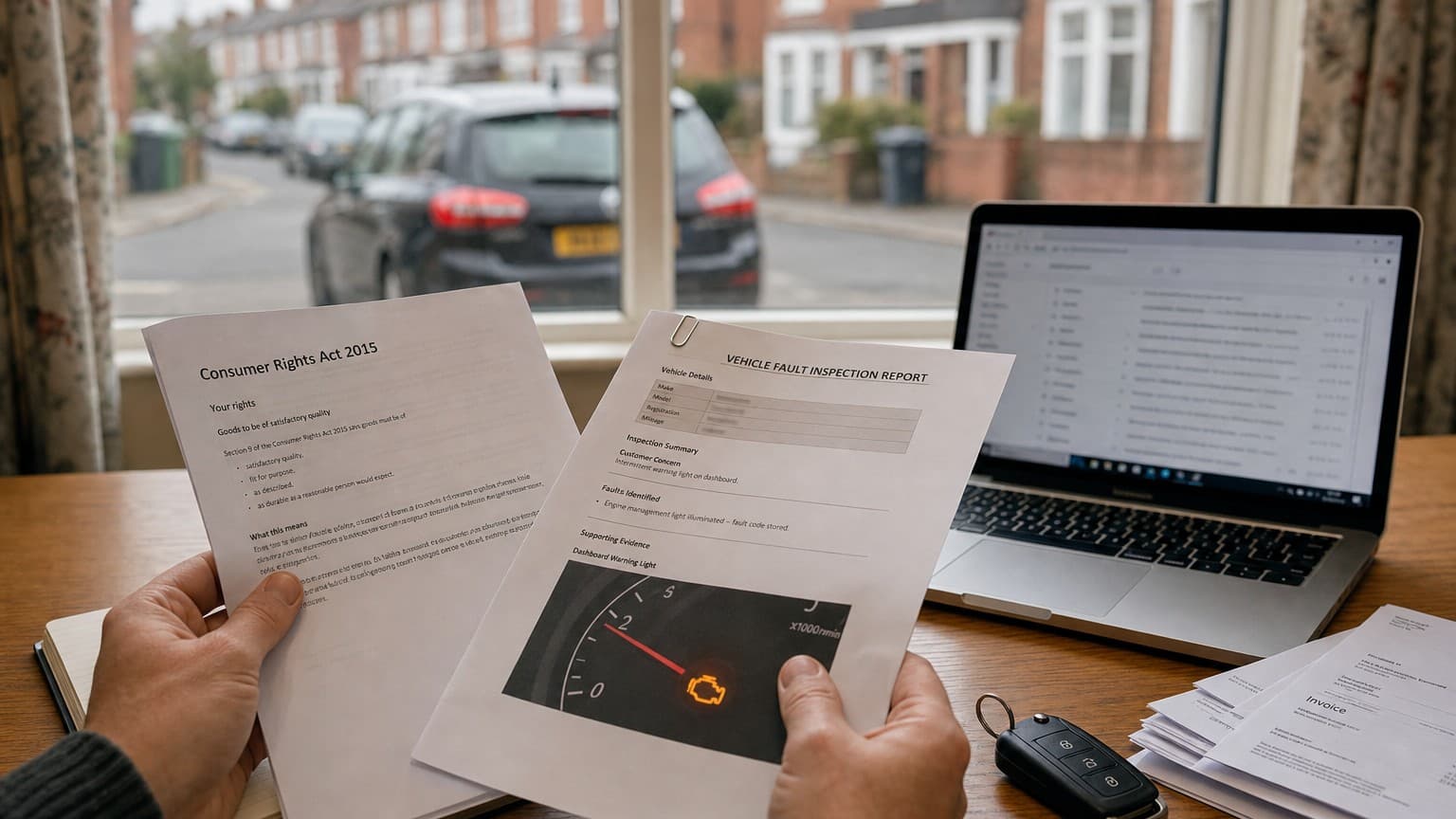
When writing to the dealer or making a complaint, citing the correct law makes a real difference. Reference the Consumer Rights Act 2015 (not the Sale of Goods Act), cite specific sections like Section 9 for satisfactory quality or Section 22 for the 30-day right to reject, and use the correct terminology – "short-term right to reject" rather than the old "reasonable time" language. Getting the law right signals to the dealer that you know your rights and makes your claim significantly harder to dismiss or fob off.

Template Wording
When writing your rejection letter:
Under Section 9 of the Consumer Rights Act 2015, goods must be of satisfactory quality. Under Section 22, I have a short-term right to reject goods that do not conform to the contract within 30 days of delivery.
The vehicle is not of satisfactory quality due to [fault]. I am therefore exercising my right to reject under Section 22 and require a full refund within 14 days.
The Bottom Line
The Consumer Rights Act 2015 replaced the Sale of Goods Act for consumer purchases and gave buyers clearer, stronger protections. The 30-day rejection window, the 6-month presumption that faults were present at sale, and the structured repair-then-reject framework all work in your favour. If a dealer references the old Sale of Goods Act, they're either out of date or hoping you are – correct them, and cite the specific sections that apply to your claim.
Need help understanding your rights under the Consumer Rights Act? Check your car – free, and we know the law inside out.