

Key takeaways
- Reject within 30 days and no deduction is allowed
- After 30 days, a deduction must match the use you actually had
- Blanket percentages and made-up per-mile rates are challengeable
- Time off the road counts in your favour
When you reject a faulty car, the dealer may try to deduct money for your "use" of the vehicle. Sometimes this is legitimate – but often they overcharge. Here's what the law says and how to challenge unfair deductions. New to the process? Start with our complete guide on how to reject a faulty car.
When deductions are allowed
Within the first 30 days, if you reject under the short-term right to reject – whether it's a used car or a brand-new one – no deductions are allowed. You're entitled to a full refund with no reduction for use whatsoever. This is explicit in Section 22 of the Consumer Rights Act 2015. If the dealer tries to deduct for use within 30 days, refuse and cite the law – there is no ambiguity here.
After 30 days, if you reject following a failed repair under Section 24, deductions may be permitted – but only if the goods have actually been used, the deduction is calculated proportionately, and it accounts for your reasonable use only. The key word is "proportionate" – not whatever the dealer feels like charging.
How fair use deductions are calculated
Under Section 24(10) of the Consumer Rights Act 2015, any deduction must reflect the use you've actually had from the goods, be proportionate to the period of use, and not be punitive. There's no single mandated formula, but three methods are commonly used.
Mileage-based calculations charge a pence-per-mile rate for miles driven. Rates of 8-15p per mile are commonly cited, but the figure should reflect actual depreciation for that type of car, not an arbitrary rate the dealer invents. Time-based calculations work on the proportion of the car's expected lifespan – if a car is expected to last 10 years, 6 months of ownership represents roughly 5%. Value-based calculations look at the difference in realistic trade value between purchase and rejection. Whichever method is used, it must be proportionate and justifiable.

See if you can reject your car. Free, in 2 minutes.
- Enter your reg
- Get your verdict
- Reject your faulty car
Free · No card · About 2 minutes
Not sure which window you are in? Put in your reg and find out, free.
What price per mile can a dealership deduct?
There is no statutory rate – the Consumer Rights Act only requires that any deduction reflects the use you've actually had. In practice, mileage-based deductions tend to fall in these ranges:
| Car at purchase | Typical per-mile range | Per 1,000 miles |
|---|---|---|
| Budget used car (under £5,000) | 5–10p | £50–£100 |
| Mid-range used car (£5,000–£15,000) | 8–15p | £80–£150 |
| Newer or premium car (over £15,000) | 15–25p | £150–£250 |
Treat these as negotiating reference points, not entitlements – the dealer must still justify their figure against your car's actual depreciation, and remember that within the first 30 days no deduction is allowed at all.
Some dealers reach for 45p per mile because it's a familiar number from HMRC's business mileage allowance. That rate is irrelevant here – it's built to cover fuel, insurance, servicing and wear, all costs you already paid while running the car. A deduction can only reflect the use you had, and a 45p rate typically triples or quadruples any defensible figure. Challenge it every time.
What's reasonable?
Several factors affect what constitutes a fair deduction: how long you owned the car, how many miles you drove, the car's age at purchase (older cars depreciate less proportionally), the price you paid, and the severity of the fault. If the car was barely usable, you've had very little "use" to deduct for.
In practice, courts take a pragmatic view. A few hundred miles over a couple of months typically justifies minimal or no deduction. Several thousand miles over many months may attract a modest deduction. Heavy use over an extended period warrants a proportionate deduction – but even then, it should be fair.
The fault's impact on use matters significantly. If the car was frequently undriveable due to faults, spent much of its time in the garage being repaired, or wasn't safe or reliable enough to use normally, you haven't had the "use" the dealer claims. Deductions should be reduced or eliminated to reflect the restricted use you actually received.
Example calculations
Scenario 1: quick rejection
- Bought for £10,000
- Rejected after 2 months and 1,000 miles
- Car had 50,000 miles at purchase
Reasonable deduction: Minimal or none. Very little use relative to the car's value.
Scenario 2: longer ownership
- Bought for £15,000
- Rejected after 8 months and 6,000 miles
- Car had 30,000 miles at purchase
Possible deduction: Perhaps £500-1,000 depending on circumstances. But if the car was faulty throughout, argue you didn't receive normal use.
Scenario 3: extensive use
- Bought for £8,000
- Rejected after 14 months and 15,000 miles
- Car had 80,000 miles at purchase
Potential deduction: Higher – but still must be proportionate. Factor in the time it was off-road for repairs.
Challenging unfair deductions
Dealers commonly try fixed percentages ("we always deduct 20%"), arbitrary rates ("£500 per month"), depreciation claims ("the car is worth less now"), and wear item charges ("we need to replace tyres and brakes"). All of these are challengeable.
To "we always deduct X%": the law requires proportionate calculation based on your actual use, not blanket policies applied to every rejection. To "you've put X miles on it": ask them to justify their per-mile rate – where does that figure come from, and how does it relate to actual depreciation for this specific car? To "the car has depreciated": normal depreciation on a working car and depreciation caused by their sale of a faulty car are fundamentally different things – you shouldn't pay for their failure to sell you a satisfactory product. To "tyres and brakes need replacing": these are wear items you'd have used regardless of the fault, though if they were already worn when you bought the car, that's their problem, not yours.
Your response letter
When no deduction should apply
Any rejection within 30 days means a full refund with no deductions whatsoever. If the car was misrepresented – clocked, an undisclosed write-off, or otherwise not as described – the contract may be rescinded entirely, meaning you can claim as if the sale never happened, with no deductions. If the car was so fundamentally faulty it was never fit for purpose, you can argue you never received any genuine "use" to deduct for. And if the car spent most of its time in the garage, off-road, or being repaired, you haven't had use to deduct.
Documenting your actual use
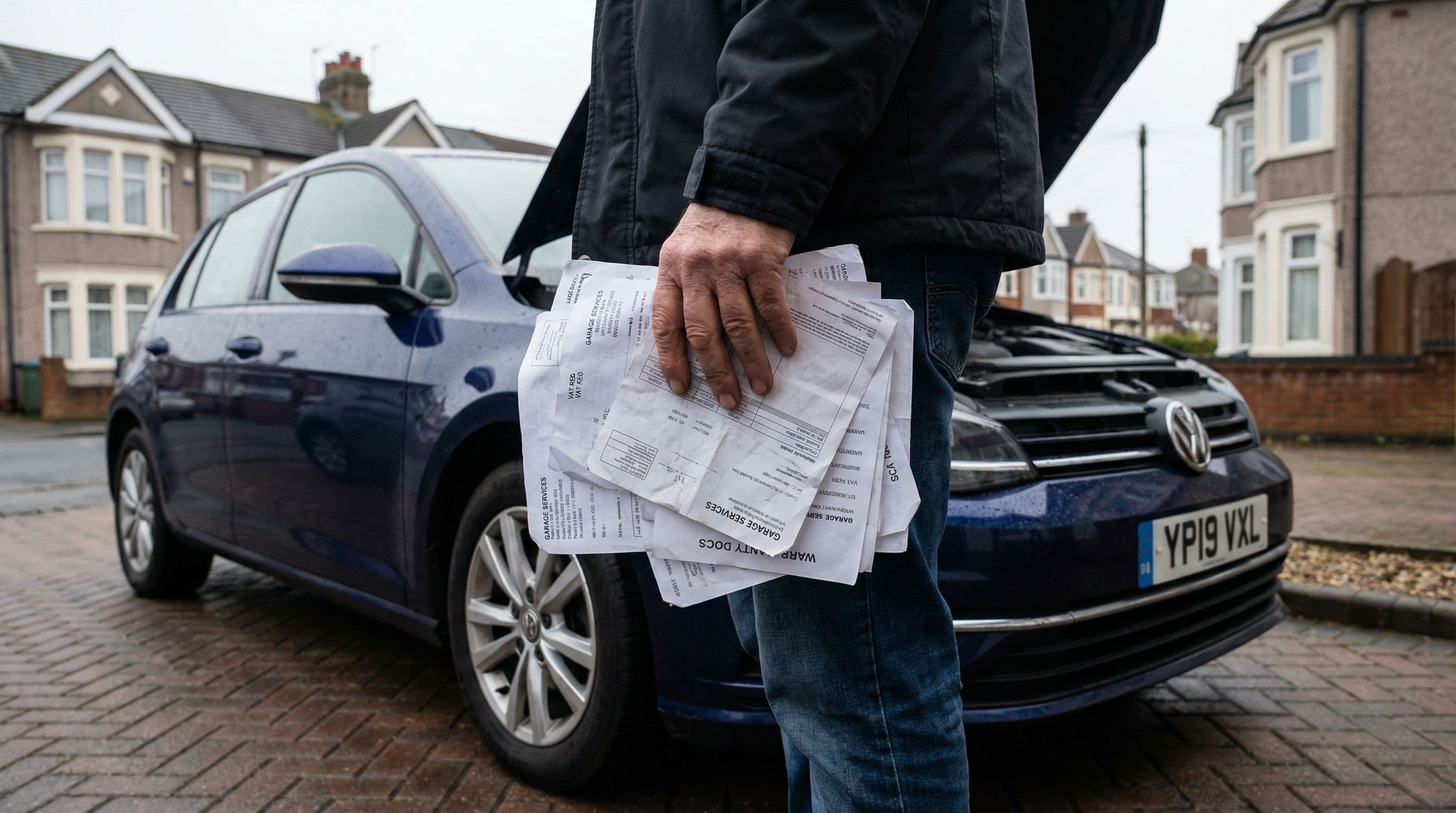
Keep records of the days the car was actually usable versus the days it was in the garage, a mileage log if possible, all repairs and time off-road, and any restrictions on use (couldn't drive long distances due to the fault, for example). This evidence directly supports your challenge to excessive deductions and gives you concrete numbers to counter the dealer's claims.

What if they won't budge?
If the dealer is a member of the Motor Ombudsman, they can adjudicate on fair deductions. If the amount in dispute is under £10,000, small claims court can determine what's fair – courts generally take a reasonable view and dislike excessive dealer deductions. If you bought on finance, your finance company may also intervene.
Sometimes it's worth compromising pragmatically. If they want £800 and you think £200 is fair, settling at £400-500 might be worth it to close the matter and avoid the time and stress of formal proceedings.
The bottom line
Within 30 days, no deductions are allowed – you're entitled to a full refund. After 30 days, deductions must be proportionate to your actual use, not punitive. Calculate your real use based on mileage, time owned, and time the car spent off-road being repaired. Don't accept arbitrary formulas or blanket percentages – some dealers overreach, and the Act sets the test. Document everything, challenge excessive amounts, and escalate to the ombudsman or court if the dealer won't see reason.
Disputing a deduction from your refund? Check your car – free, and we'll help you negotiate a fair outcome.
Related topics