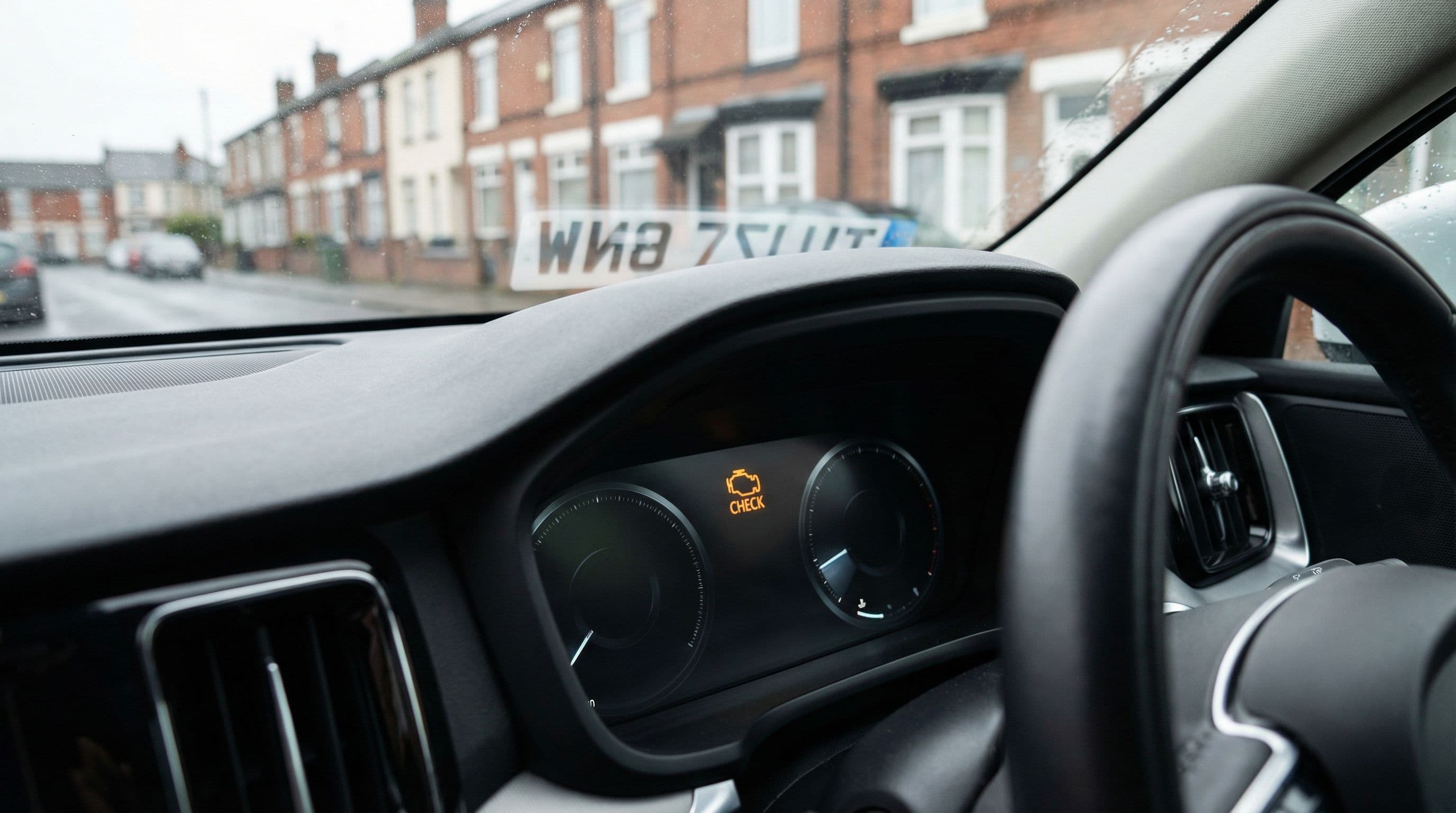
You've just bought a car and the engine warning light has come on. This is one of the most common problems buyers face – and one of the most frustrating when dealers try to dismiss it.
What Does the Engine Warning Light Mean?
The engine management light (EML), also called the check engine light, indicates a fault has been detected by the car's computer (ECU). It could be something relatively minor – a loose fuel cap, a sensor malfunction, an emissions system fault, or a software glitch – or something far more serious: catalytic converter failure, MAF or MAP sensor problems, oxygen sensor faults, a misfiring engine, timing issues, or fuel injection problems.
The core problem is uncertainty. Without a diagnostic scan, you can't know if it's a £50 fix or a £5,000 problem – and that uncertainty alone makes the car unsatisfactory. No reasonable buyer would consider a car with an undiagnosed engine fault to be in acceptable condition.
Your Consumer Rights
The Car Must Be Satisfactory
Under Section 9 of the Consumer Rights Act 2015, a car must be of satisfactory quality. A car with an illuminated warning light, an undiagnosed fault, and uncertainty about its mechanical condition is not satisfactory – regardless of what's actually causing the light. Even if the underlying issue turns out to be minor, the warning light itself is a problem: an illuminated EML is an automatic MOT failure, it makes the car harder to sell, and it creates genuine uncertainty about whether the car is safe to drive.
If the warning light appeared within 30 days of purchase, you can reject the car outright without accepting any repair attempt.
Did the Dealer Clear Fault Codes?
This is crucial. Many dealers clear fault codes before selling to hide problems – it's one of the most common tricks dealers use. The telltale signs include the light coming on shortly after purchase (because the fault returned after being cleared), "pending" codes that haven't yet triggered the warning light, a pattern of multiple related fault codes suggesting ongoing issues, and timestamps showing when codes were last cleared.
If a diagnostic scan reveals that codes were recently cleared and the same fault has reappeared within days or weeks, this strongly suggests the dealer knew about the problem and deliberately concealed it. This may constitute fraud.
Think you might have a claim?
Check if you're entitled to a refund under the Consumer Rights Act. Free, takes 2 minutes.
What to Do Immediately
Get a diagnostic scan before contacting the dealer. Take the car to an independent garage (or use an OBD reader) and have them read all stored fault codes. Ask for a printed report showing the codes, their descriptions, and – if the system records this – when the codes were first set. This report is your most important piece of evidence.
Record the circumstances – note exactly when the light came on, your mileage at purchase versus current mileage, any symptoms you've noticed (rough running, loss of power, unusual smells), and any patterns such as the light only appearing on cold starts or at certain speeds.
Do not clear the codes. They're your evidence. If you clear them, you lose proof of what was wrong and when the fault was logged.
Contact the dealer in writing. Don't just phone – email or write so you have a record of everything. Keep copies of all correspondence.
What to Write to the Dealer
To: [Dealer]
Re: Engine Warning Light – [Registration]
Dear Sir/Madam,
On [date], I purchased [vehicle make/model] from you at [mileage] miles for £[price].
On [date], at [current mileage] miles, the engine management light illuminated. I have had a diagnostic scan performed which revealed the following fault codes:
[List codes and descriptions]
This vehicle is not of satisfactory quality under Section 9 of the Consumer Rights Act 2015:
-
Fault indication – The illuminated warning light indicates a malfunction that requires investigation.
-
MOT status – An illuminated engine management light would cause an MOT failure.
-
Pre-existing issue – I have added only [X] miles since purchase. The fault codes [and cleared code history] indicate this problem existed when the vehicle was sold.
[Within 30 days]: As I am within 30 days of purchase, I am exercising my right to reject this vehicle under Section 22 of the Consumer Rights Act 2015 and require a full refund.
[After 30 days]: I require you to repair this fault promptly and at no cost to me.
Please respond within 14 days confirming how you intend to resolve this.
Yours faithfully, [Your name]
Dealer Responses
"Just drive it and see if it goes away"
No. You shouldn't have to "live with" a warning light. It indicates a fault and affects MOT status. Reject this suggestion.
"It's just a sensor"
Even "just a sensor" needs fixing. Sensors can cost hundreds to replace, a faulty sensor may be masking other problems, and it's still a fault that was present when you bought the car. The word "just" doesn't make it acceptable.
"We'll clear the code and see"
Clearing codes without fixing the underlying cause isn't a repair – it's a delay. The light will almost certainly come back, nothing has actually been fixed, and you'll be in the same position weeks later with more mileage on the clock. Insist on proper diagnosis and a genuine repair.
"The code is old – nothing to worry about"
Old codes that weren't addressed are still faults. If anything, their age proves the problem existed before you bought the car.
Within 30 Days: Your Strongest Position
If the warning light appeared within 30 days, you have an automatic right to reject for a full refund. You don't have to accept repairs – the law presumes the fault existed at purchase, and you're entitled to walk away. Don't be talked into "just trying a repair" if you want to reject.
Recommended reading


After 30 Days
After 30 days but within 6 months, the dealer can offer one repair attempt, and you should allow a reasonable time for them to carry it out. If the repair fails or takes too long, you can then reject. The fault is still presumed to have existed at purchase during this period, so the burden remains on the dealer to prove otherwise.
If they "fix" it but the warning light returns, that's a failed repair – you can now reject even if you're past the initial 30 days. Document each recurrence with dates, mileage, and diagnostic scans. If the dealer then ignores your rejection, see our guide on what to do when a dealer ignores your rejection.
MOT Implications
Since 2018, an illuminated engine management light causes an automatic MOT failure. The car is potentially not roadworthy, you cannot legally MOT it until the fault is resolved, and you may need to SORN it if the MOT expires while you're waiting for the dealer to act. By any measure, a fault that causes MOT failure is a significant defect.
Finance Protection
If you used PCP, HP, or a credit card to buy the car, the finance company is jointly liable for its quality. Contact them alongside the dealer – they can often pressure reluctant dealers to act, and you can claim directly against them if the dealer refuses to cooperate.
Evidence to Gather
For a strong case, you'll need a diagnostic printout showing all stored fault codes, photographs of the dashboard warning light illuminated, a record of exactly when the light first appeared, a mileage comparison between purchase and current readings, notes on any symptoms you've noticed, and copies of all communication with the dealer. The more thorough your documentation, the stronger your position – see our full guide on what evidence you need to reject a car.
Common Fault Codes and What They Mean
Generic powertrain codes (P0xxx) are the most common. P0300-P0312 indicate misfires, P0171/P0174 relate to fuel/air mixture problems, P0420/P0430 flag catalytic converter efficiency issues, and P0101-P0104 point to mass airflow sensor faults. Manufacturer-specific codes (P1xxx) vary by make – have them decoded by someone familiar with your car brand.
The cost implications range widely: an oxygen sensor replacement costs £100-300, a MAF sensor £100-400, ignition coils and spark plugs £150-500, a catalytic converter £500-2,000+, and timing-related repairs potentially £1,000 or more. This uncertainty about repair costs actually strengthens your argument that the car isn't satisfactory – you're left bearing the risk of a problem you didn't create.
The Bottom Line
An engine warning light indicates a fault, full stop. It doesn't matter whether the underlying cause turns out to be minor or catastrophic – the light itself is an MOT failure, it affects the car's value, and it means the car wasn't of satisfactory quality when sold. Get a diagnostic scan immediately to understand what codes are stored, don't let the dealer clear codes without a genuine repair, and document everything. Within 30 days you can reject outright; after 30 days, allow one repair attempt and reject if it fails. Don't accept vague reassurances – insist on proper diagnosis and a proper fix.
Engine warning light on your recently purchased car? Check if you qualify for our rejection service – we'll help you get a refund.