Hybrid Car Names Are 'Utterly Bewildering' Motorists
Car manufacturers' confusing hybrid terminology is leaving British drivers baffled by technology choices. From 'mild hybrids' that aren't really electric to 'self-charging' claims that sound like perpetual motion.
British motorists are being bamboozled by a bewildering array of hybrid car terminology that makes choosing the right powertrain as clear as mud, according to Autocar.
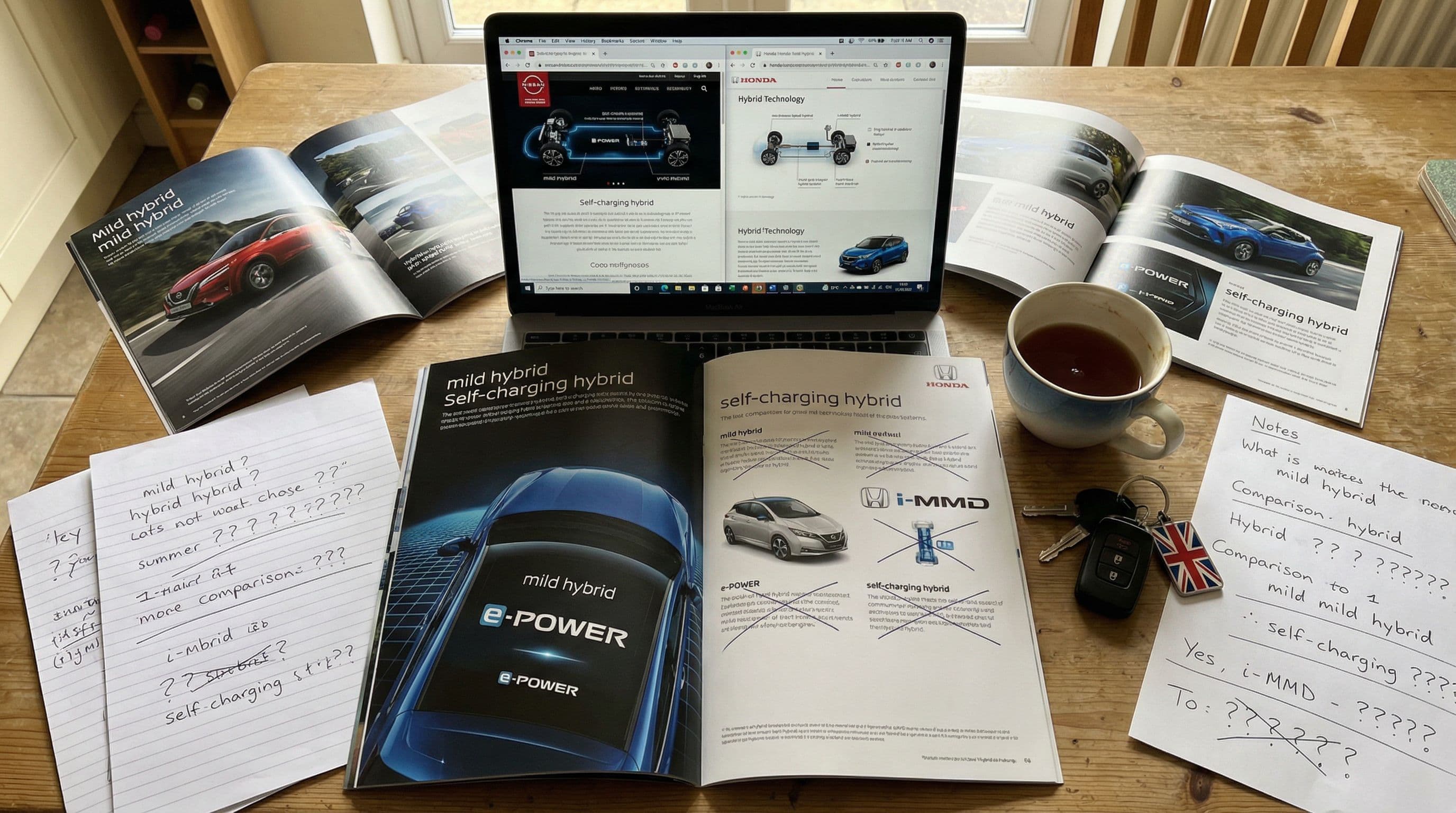
From HEV and MHEV to Super Hybrid, REx, P REEV, DM-i and EM-i, the automotive industry has created a alphabet soup of confusing brand-specific names that would challenge even the most dedicated car enthusiast.
The 'Mild Hybrid' Myth
Perhaps the most misleading term is 'MHEV' – standing for 'mild hybrid electric vehicle' – which is routinely slapped onto petrol or diesel cars equipped with little more than a beefed-up starter motor. As one industry observer noted, calling these cars 'electric vehicles' is like saying "a person wearing roller skates is a train."
Most mild hybrids use an integrated starter-generator (ISG) that can harvest some energy during braking and provide a small boost during acceleration. Some feature a small electric motor in the gearbox or even an electric turbocharger. What unites them all is a crucial limitation: they cannot drive on electric power alone.
'Self-Charging' Sounds Like Science Fiction
Toyota's marketing department coined the term 'self-charging hybrid' for the Prius, which whilst accurately conveying that owners needn't plug them in, makes the cars sound suspiciously like perpetual motion devices.
Full hybrids – increasingly called 'strong hybrids' to distinguish them from their mild cousins – can actually drive using electric power alone under light loads. However, their capabilities vary dramatically between manufacturers.
Stellantis and Audi hybrids manage just 25-30 electric BHP, offering minimal electric-only running. Meanwhile, Toyota, Renault, Honda and Nissan systems can cover impressive distances in town with the engine switched off, delivering excellent urban fuel economy.
The trade-off? Most perform disappointingly on motorways, where the electric motor is often too short-geared for efficient high-speed cruising.
Plug-In Confusion
Plug-in hybrids should be self-explanatory, but even here there's potential for buyer bewilderment. These systems typically use similar mechanical layouts to regular hybrids but pack bigger motors and batteries that can be charged from the mains.
The critical caveat for buyers: consistently plug them in and avoid using the engine much, and you'll achieve incredible MPG figures. Forget to plug in regularly, and you'll be lugging around an extra 200kg of dead battery weight, resulting in terrible economy.
Range-Extender Reality Check
Range-extender EVs add another layer of complexity. The BMW i3 REx and Mazda MX-30 R-EV pioneered this approach – short electric-only range supplemented by a tiny petrol engine that generates extra electricity (noisily and inefficiently) in emergencies.
Newer models like the Leapmotor C10 Hybrid EV follow similar principles, with engines that never directly drive the wheels. For most buyers though, the driving experience differs little from conventional plug-in hybrids.
The Bottom Line for Buyers
Despite the bewildering terminology, the fundamental question for British motorists remains refreshingly simple: does it need plugging in or not?
For those interested in the mechanical intricacies – Toyota's planetary gearsets, Nissan's generator-only engines, or Honda's novel power-blending gearboxes – the engineering diversity is genuinely fascinating. For everyone else, it's largely a case of selecting 'D' and letting the computer sort things out.
In an increasingly digital automotive world, there's still something satisfying about traditional cogs interfacing – even if understanding what manufacturers choose to call them requires a degree in marketing mystification.